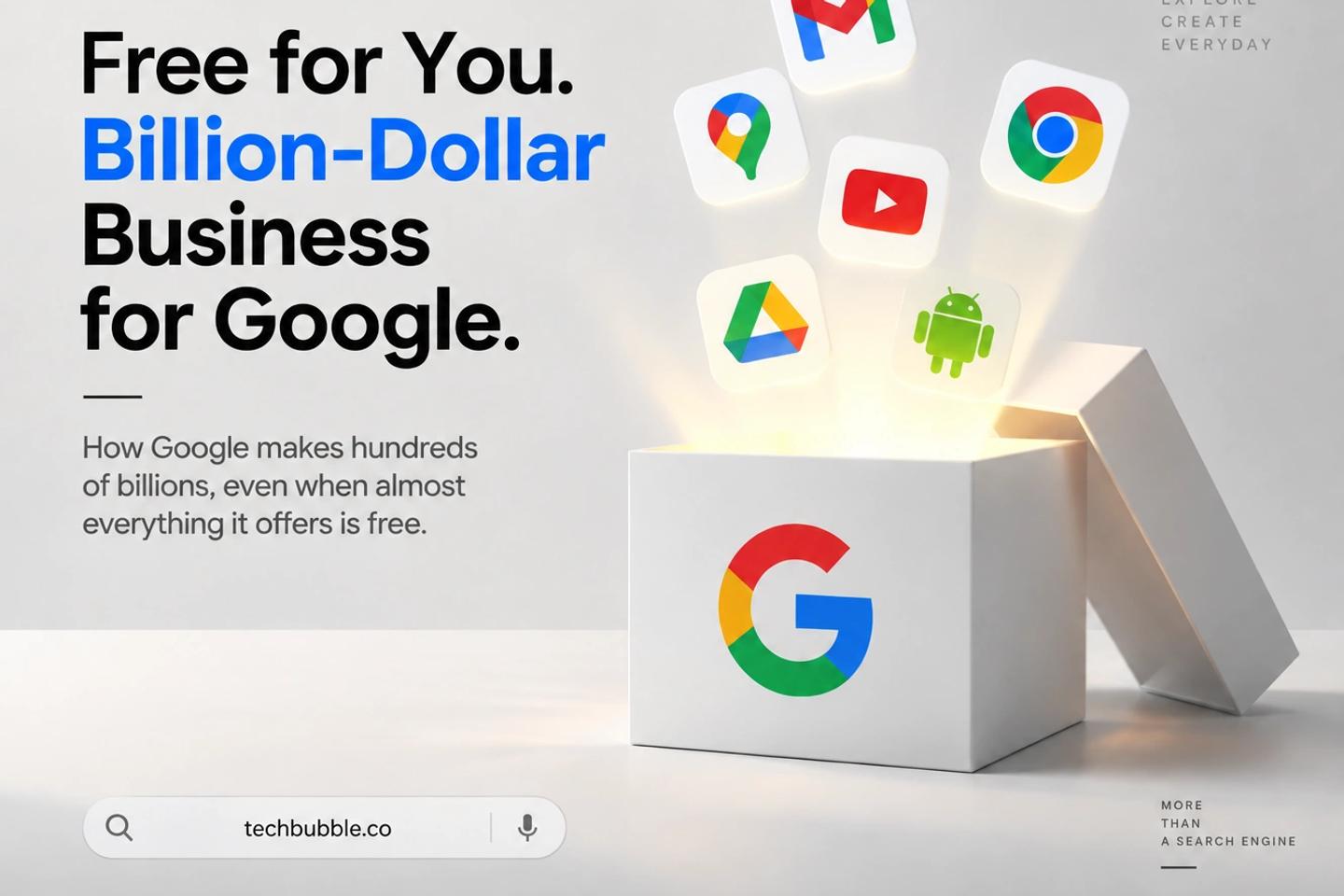
Free for You. Billion Dollar Business for Google.
Google Gives Everything Away for Free — So How Does It Make Hundreds of Billions?
The hidden business model behind the world’s most generous-looking company
Every day, billions of people use Google without paying a single dollar.
You wake up and check Gmail.
You open Google Maps to find a location.
You search something on Google.
You watch videos on YouTube.
You use Android on your phone.
You store photos and files on Google services.
The price of all these services?
$0.
So naturally, a question comes to mind:
If Google gives away almost everything for free, how does it make hundreds of billions of dollars every year?
The answer reveals one of the smartest business models ever created.
The Real Product Is Not the Service — It’s Your Attention
Most people think Google sells search, email, or maps.
It does not.
Google’s biggest product is something much more valuable:
Human attention.
Every time you search something on Google, you are revealing information:
- What are you interested in?
- What problem are you trying to solve?
- What products are you considering buying?
- Where are you planning to travel?
- What brands attract you?
This information helps Google understand users better than almost any company in history.
And businesses are willing to pay enormous amounts to reach those users.
The Billion-Dollar Machine Behind a Simple Search Box
Imagine someone searches:
“Best running shoes for beginners”
Google understands that this person may be interested in buying shoes.
A shoe company can pay Google to show its advertisement at the top of the search results.
The company does not pay because Google has a search engine.
It pays because Google can connect the company with a potential customer at the exact moment they are looking for something.
This is the magic of Google’s advertising model.
Advertising: The Engine That Powers Google
Google’s main revenue comes from advertising.
Companies around the world spend billions to appear in front of customers through:
- Google Search Ads
- YouTube Ads
- Display advertisements
- Shopping advertisements
Unlike traditional advertising, Google’s system is extremely targeted.
A television advertisement reaches millions of people, but many viewers may not care.
Google can show an advertisement to someone who is already searching for that exact product.
That makes advertising much more valuable.
But Is Google Selling Our Personal Data?
This is one of the biggest misunderstandings about Google.
Many people believe:
“Google sells my personal information to advertisers.”
Generally, Google’s advertising system works differently.
Advertisers usually do not receive your personal identity. Instead, Google uses large amounts of data to categorize audiences and decide which advertisements are more relevant.
For example:
A travel company may want to show ads to people interested in travelling to Japan.
Google can identify users who may have that interest and display relevant advertisements.
The advertiser pays Google — not the user.
Why Keep Services Free Then?
Because free services create a powerful cycle.
More users → More data → Better products → More advertisers → More revenue
For example:
- Google creates Gmail for free.
- Billions of people start using Gmail.
- Google learns how people interact with digital services.
- Businesses want access to Google's massive audience.
- Companies pay for advertising.
The free product becomes the foundation of a massive business ecosystem.
Android: The Free Operating System That Controls a Billion Devices
Android is another brilliant example.
Google does not usually charge phone manufacturers billions to use Android.
Instead, Android places Google services at the centre of the mobile experience:
- Google Search
- Google Play Store
- Google Chrome
- Google Assistant
Every Android phone becomes another doorway into Google’s ecosystem.
The operating system may be free, but the users it brings are incredibly valuable.
Google Maps: A Free App With Huge Business Value
Google Maps looks like a simple navigation tool.
But behind the scenes, it creates enormous commercial opportunities.
When someone searches:
- “restaurant near me”
- “coffee shop nearby”
- “hotel in Sydney”
Businesses want to appear in those results.
Google Maps has transformed local advertising.
A small restaurant can now compete digitally with larger brands by paying for visibility.
The Hidden Advantage: Scale
Google’s greatest strength is not one individual product.
It is the connection between all its products.
Search connects with YouTube.
YouTube connects with advertising.
Android connects with mobile users.
Maps connects with local businesses.
Chrome connects users to the internet.
Each service strengthens the others.
This creates a digital ecosystem that is extremely difficult for competitors to replicate.
The Cost of Free
However, the “free” internet is not completely free.
Users pay in another way:
- Their attention
- Their digital behaviour
- Their interaction patterns
This raises important questions about privacy, competition, and the power of technology companies.
When one company becomes the gateway to information, communication, navigation, and entertainment, its influence becomes enormous.
The Bigger Lesson
Google’s story teaches an important business lesson:
The most valuable companies do not always sell expensive products.
Sometimes, the smartest strategy is to give something away.
Build trust.
Build habits.
Build an ecosystem.
Then create value around that ecosystem.
Google did not become one of the world’s most powerful companies by charging people for search.
It became powerful because it understood something fundamental:
When you control the connection between people and information, you control one of the most valuable resources in the modern economy.