AI Gets the Blame, But the World’s Biggest Water Consumers Are Not Who You Think
Artificial intelligence has become the latest target in the global water debate. From data centres consuming millions of litres of water for cooling to concerns about the environmental cost of training large AI models, headlines often suggest that AI is creating a new water crisis.
But a closer look at global water consumption reveals a different story.
While AI infrastructure is growing rapidly, the world’s largest corporate water users are still dominated by traditional industries — especially food, beverages, and consumer goods. Companies that manufacture bottled drinks, dairy products, food items, and household products have been consuming billions of litres of water for decades.
The real question is not whether AI uses water. It does. The bigger question is: why are emerging technologies receiving more attention than industries that have historically consumed far more water?
The Water Footprint of Global Corporations
According to industry estimates, some of the world’s largest consumer companies use thousands of millions of litres of water annually across their global operations.
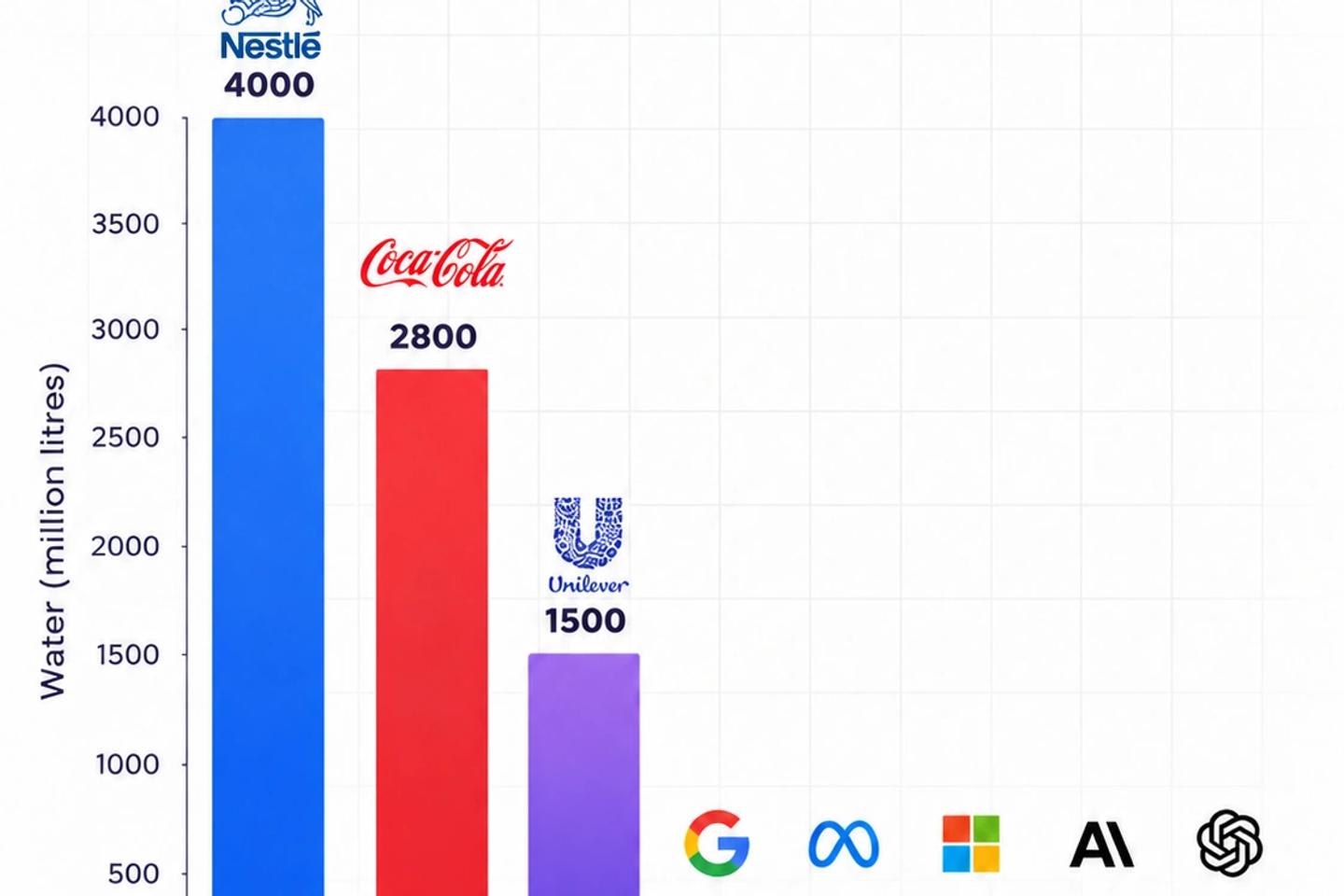
Leading the list is Nestlé, with approximately 4,000 million litres of water consumption, followed by The Coca-Cola Company at around 2,800 million litres, and Unilever at nearly 1,500 million litres.
These numbers are connected to the nature of their businesses. Water is not only used in factories; it is embedded throughout their supply chains — from growing agricultural ingredients and processing raw materials to cleaning equipment and manufacturing final products.
For example, producing beverages requires water as both an ingredient and a production resource. Similarly, personal care products, packaged foods, and agricultural supply chains depend heavily on freshwater availability.
Where Does AI Fit Into This Picture?
Artificial intelligence companies have recently entered the water conversation because of the rapid expansion of data centres.
AI models require enormous computing power. Servers generate significant heat, and many data centres use water-based cooling systems to maintain safe operating temperatures.
Companies such as Google, Microsoft, Meta Platforms, Anthropic, and OpenAI have become symbols of the AI industry's environmental footprint.
However, compared with traditional consumer giants, their direct water consumption remains much smaller.
The estimated figures shown in the chart indicate:
- Google: approximately 48 million litres
- Meta: approximately 10 million litres
- Microsoft: approximately 0.78 million litres
- Anthropic: approximately 0.15 million litres
- OpenAI: approximately 0.05 million litres
Although these numbers are significantly lower than traditional corporations, the concern around AI is not only about current consumption — it is about future growth.
Why AI Water Consumption Still Matters
The reason AI attracts attention is its unprecedented expansion.
Unlike traditional industries that have developed gradually over decades, AI infrastructure is scaling at an extraordinary speed. Every new AI model requires:
- More powerful processors
- Larger data centres
- Greater electricity demand
- More cooling requirements
A single large-scale data centre can consume substantial amounts of water, especially in regions where cooling systems rely on freshwater.
This creates a serious challenge because many data centres are located near major technology hubs that already face water stress.
For communities experiencing drought or limited water availability, even relatively small industrial increases can create tension between technology development and public needs.
The Hidden Cost of Digital Progress
The AI revolution has created enormous benefits:
- Faster scientific research
- Improved healthcare technologies
- Better climate modelling
- Increased business productivity
- New educational opportunities
However, every digital service has a physical foundation.
Behind every chatbot, image generator, and AI application are massive computing facilities requiring:
- Land
- Electricity
- Hardware materials
- Cooling resources
- Water management systems
The idea that digital technology is completely “clean” because it has no visible physical product is misleading.
Who Should Be Responsible?
The debate should not become a competition between AI and traditional industries. Instead, companies across all sectors need stronger environmental responsibility.
Technology companies should focus on:
- Developing water-efficient cooling systems
- Using recycled or non-potable water
- Building data centres in regions with sustainable water resources
- Improving AI model efficiency to reduce computing demand
Traditional industries should also address:
- Agricultural water waste
- Supply-chain transparency
- Factory efficiency
- Sustainable production methods
Large corporations across every sector must recognise that water is becoming one of the most valuable resources of the 21st century.
The Future: A Balance Between Innovation and Sustainability
AI is not the biggest corporate water consumer today, but it represents a rapidly growing challenge. The world cannot ignore the environmental impact of emerging technologies simply because older industries consume more.
At the same time, blaming AI alone creates an incomplete picture.
The future will require a more balanced approach: continuing technological innovation while ensuring that progress does not come at the expense of essential resources.
The real lesson is clear:
The water crisis is not caused by one industry. It is the result of how modern society produces, consumes, and manages resources. AI is only the newest chapter in a much larger story.